Монтаж домашних кинотеатров in 2024: what's changed and what works
Home theater installation has transformed dramatically over the past year. The tech has gotten smarter, the expectations higher, and honestly, some of the old rules just don't apply anymore. If you're planning to set up a cinema room in 2024, here's what actually matters now—straight from someone who's seen installations go brilliantly right and spectacularly wrong.
1. Wireless Isn't the Compromise It Used to Be
Remember when wireless rear speakers meant accepting crackling audio and random dropouts? Those days are dead. WiSA-certified systems now deliver 24-bit audio at 96kHz with less than 5 milliseconds of latency. That's imperceptible to human ears, even for the pickiest audiophiles.
The real game-changer is installation time. A full 7.2.4 Dolby Atmos setup that used to require two days of cable fishing through walls? Now you're looking at 4-6 hours for the same result. Companies like Enclave and Platin have systems where the subwoofer acts as the wireless hub, eliminating the need for a separate transmitter box cluttering your equipment rack.
Just one caveat: wireless still needs power. You'll need outlets near each speaker location, which some people forget until they're halfway through the install.
2. Projectors Have Finally Beaten Big TVs on Brightness
The 2024 crop of laser projectors from Epson, Sony, and JVC are pushing 3,000-4,000 lumens while maintaining actual contrast ratios above 100,000:1. Translation? You can watch with ambient light without the image looking washed out like a faded photograph.
Ultra-short-throw models have gotten ridiculously good too. Position them 8-10 inches from the wall and get a 120-inch image that rivals what you'd see in a commercial cinema. The Hisense PX3-PRO sits at around $3,000 and delivers HDR performance that would've cost $15,000 two years ago.
3. Acoustic Treatment Isn't Optional Anymore (But It's Easier)
Here's something nobody tells you: a $20,000 speaker system in an untreated room sounds worse than a $3,000 system with proper acoustics. The difference is that jarring.
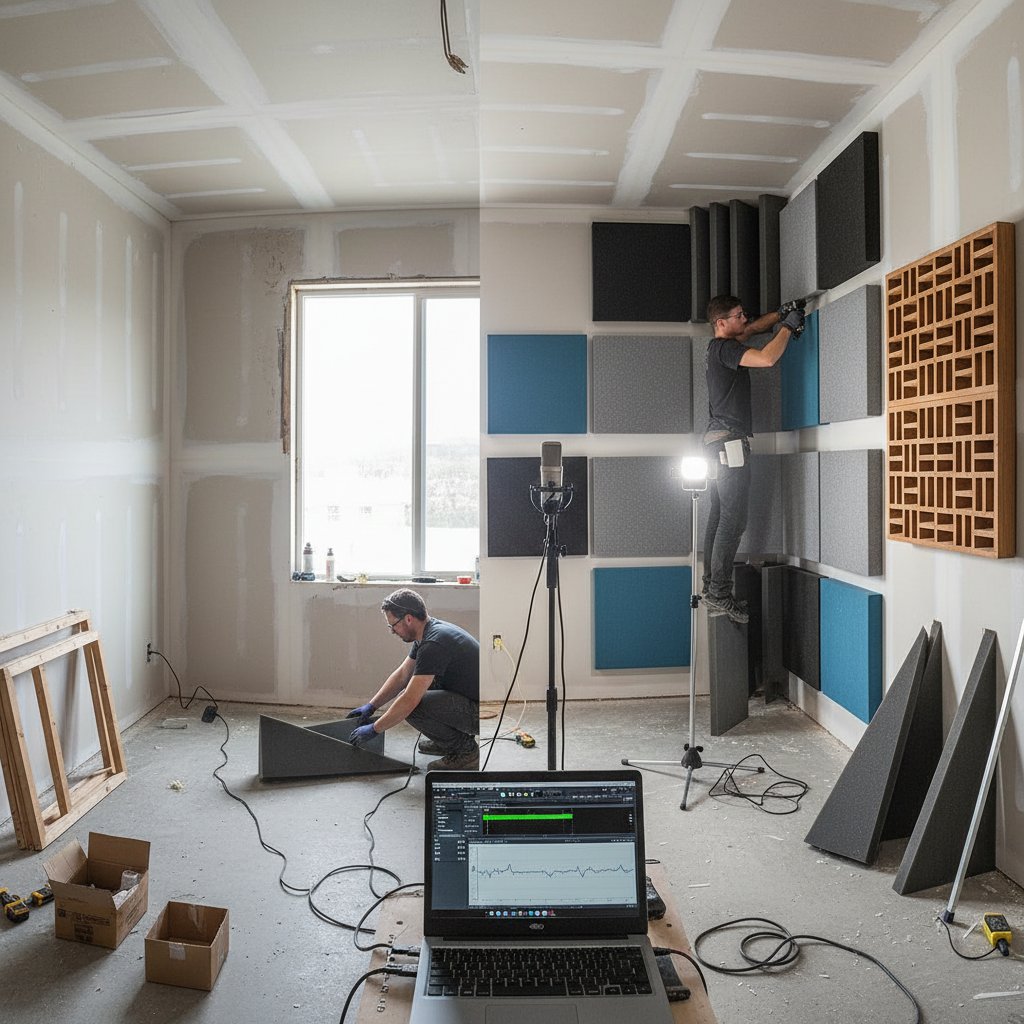
The good news? Acoustic panels in 2024 look like actual art pieces. Companies like GIK Acoustics and ATS Acoustics offer printed panels that blend into your décor—nobody needs to know they're functional. Budget around $800-1,200 for a medium-sized room. Focus on the first reflection points on side walls and something to tame bass in the corners. Even basic treatment eliminates that boomy, echo-chamber effect that ruins dialogue clarity.
DIY acoustic treatment has exploded too. Rockwool insulation wrapped in acoustically transparent fabric costs about $200 for materials and works nearly as well as premium panels.
4. Calibration Apps Have Gotten Scary Accurate
Professional calibration used to mean paying someone $500-800 to show up with a spectrophotometer and spend six hours tweaking settings. Now? Apps like CalMAN for mobile devices and built-in systems like Dirac Live get you 90% of the way there for under $100.
Most 2024 AV receivers from Denon, Marantz, and Anthem include room correction that actually works. They measure speaker distance, adjust timing, and compensate for room acoustics automatically. The Anthem AVM 90 takes this further with Genesis mode, which literally maps your room in 3D using microphone measurements from multiple positions.
5. Modular Design Beats Permanent Installation
People move. Tastes change. Technology evolves faster than drywall repairs. The smartest installations in 2024 embrace flexibility.
Surface-mount speakers have improved so much that in-wall installation rarely makes sense unless you're building new construction. Brands like KEF and DALI make compact speakers with magnetic grilles that look intentional, not like an afterthought. Pair them with color-matched cable raceways, and you get a clean look without the permanence.
Equipment racks have gone modular too. Open-frame racks let you reorganize components in minutes instead of hours. When you upgrade that receiver or add a streaming device, you're not playing Tetris with a closed cabinet.
6. Streaming Has Finally Caught Up to Physical Media (Mostly)
Apple TV 4K now supports full-bandwidth Dolby Atmos and Dolby Vision. So does the Nvidia Shield Pro. Streaming bitrates have climbed to 25-40 Mbps for premium content—not quite the 80-100 Mbps you get from Ultra HD Blu-ray, but close enough that most people can't tell the difference on screens under 85 inches.
The catch is your internet connection. You need a consistent 100 Mbps download speed minimum. Anything less and you'll get compression artifacts during action scenes. Hardwire your streaming device with ethernet—Wi-Fi 6 is good, but a cable is bulletproof.
Physical media still wins for true reference quality, but the gap has narrowed to the point where maintaining a disc library feels more like enthusiasm than necessity.
Setting up a home theater in 2024 means embracing technology that actually delivers on its promises. The wireless works, the projectors shine, and the calibration doesn't require an engineering degree. Focus on the fundamentals—good acoustics, proper calibration, and quality sources—and you'll build something that still impresses years from now.